10 April 2020

BOOK EXCERPT: Walking the Via Dolorosa

Book, Figure 36
For this very unusual Good Friday during the Pandemic of 2020, when for the first time in centuries the streets of Jerusalem may well be almost empty of pilgrims, I decided to share the account of my own walking the Via Dolorosa during my pilgrimage to the Holy Land in August 2018, as recounted in my new book, Holy Ramblings: Travelogues, Commentaries, and Meditations on Pilgrimages Far and Wide, available through links at www.holyramblings.com.

It was our last day on the ground, in the afternoon, after spending the day walking down the Mount of Olives from the site of the Ascension to the Basilica of the Agony (also called the Church of All Nations), lunch and a short tour of the Holy Shroud exhibit at the Notre Dame Centre, and entering the Old City of Jerusalem through the Lions’ Gate and visiting the Church of St. Anne and the adjacent ruins of the Pools of Bethesda….

27 March 2020

Pilgrimage in a time of Pestilence


Presenting a chapter from my new book about pilgrimage – HOLY RAMBLINGS: Travelogues, Commentaries, and Meditations on Pilgrimages Far and Near. Available in ebook and print formats: www.holyramblings.com
Well, a week or so ago, just when this period of enforced solitude was beginning, I was talking with the office manager of my parish, the Minor Basilica of the Immaculate Conception, Natchitoches, Louisiana, and I asked her, “Does my timing suck, or what?” After months of work, much longer than I anticipated when I started this project back in the summer, I finally had received a box full of paperbacks, was ready to seek permission from the rector of the basilica to place a few in the gift shop, and announce their availability there as well as from the online merchants that can be accessed through the link above. Then this happened, the new world of social distancing went into effect, public Masses were suspended indefinitely in the Diocese of Alexandria, and the gift shop closed. I ultimately decided on the smaller-scale online roll-out that I started Wednesday evening via Facebook, of which this is a continuation – with a bonus.
Besides meditation on what exactly pilgrimage is and why it seems to be an almost exclusively Catholic thing among modern Christians, followed by detailed day-by-day narratives of my three “big” pilgrimages over the past few years – to Rome and Italy, to the Shrine of Our Lady of Guadalupe in Mexico City, and to the Holy Land – I also spend a couple of chapters surveying the wider world of pilgrimage, discussing the most popular destinations around the world as well as these United States. With the world currently on shutdown, however, the pilgrimage industry as well as basically any other nonessential travel at virtually any level has screeched to a halt. Quarantine, “stay-at-home,” call it what you will, suddenly we are all largely confined to our abodes with a great deal of time on our hands even if we are part of this grand new experiment in work-from-home, “telecommuting,” again call it what you will. What better way to spend some of that time than going on a pilgrimage?
After those surveys of “pilgrimages far” (around the world) and “near” (around the United States), I tackle the subject of “pilgrimages here,” at home – literally – by various means including the new possibilities afforded by modern technology. Here follows that chapter, with commentary after….

17 November 2019

35th Anniversary Trip - New Orleans, Lousiana

Our Lady of Prompt Succor
Thirty-five years ago today my wife and I married, on the day before my 23rd birthday. Do the math yourself. Last weekend we decided to make a weekend of it in New Orleans. Besides wandering around a bit in the French Quarter, we made a micro pilgrimage out if it by going to two shrines we'd never been to before. Here is an account of the past couple of days….

Friday 15 November
We drove from Natchitoches to New Orleans, checked in to the Prince Conti Hotel in the French Quarter, at 830 Conti Street, just a block from Bourbon Street. It was a nice room, overlooking the street, but were we to stay here again, we would ask for something not facing the street. It was quite loud late into the early morning hours. We walked from there a couple of blocks along Dauphine Street to Deanie’s Restaurant, where we had a really nice meal. While we waited to be seated, Anne had an Amaretto Sour and I had an Old Fashioned – excellent! After the meal, we walked back to the hotel and settled in for the evening.

27 July 2019

Friday 26 July – The Shroud of Turin Museum, Cathedral of St. John Berchmans, Shreveport, Louisiana

Source: Museum web page [LINK]
Yes – Shreveport, Louisiana.

Shreveport, Louisiana, possesses the third-largest collection of materials related to the Holy Shroud of Turin in the world. Which is absolutely amazing, when you think about it. How did Shreveport come to be the home of such treasures?

The tale can be told a couple of different ways. I will start it in Shreveport itself, with a happy confluence of events bringing together two individuals with longstanding interest in the Shroud.

02 May 2019

Why was our tour of the Painted Churches a "Pilgrimage"?


Medieval Pilgrims [Source: LINK]
The web site of the Greater Schulenburg Chamber of Commerce (LINK) refers to visits to the Painted Churches around Schulenburg as “tours,” whether contracted through the Chamber with one of their guides such as was ours [LINK], or “self-guided.” In contrast, I call what we undertook a “pilgrimage.” What is the difference?

03 April 2019

Wednesday 03 April -- 2019 Texas Painted Churches Day 3

Blue Bell and Bluebonnets -- It's Texas!
Today was the journey home, and although I hoped to squeeze in one more Painted Church, it was not to be.

We got Blue Bell ice cream, though!

Briefly, I slept in again until almost 08:00, then Anne and I went down to the lobby for breakfast. It was full -- a condition worsened by the hotel booking an 08:00 private meeting in a closed-off part of the dining area during the posted breakfast hours. Not cool! The worker minding the breakfast bar was very apologetic, and oversaw pulling together some of the lounge furniture as a makeshift expansion to the dining area that some of us used.

Some of our party had left already; others passed through on their way out as we ate; some visited with us. In all, I think we were probably all out of the hotel by 09:30 or so, going our separate ways.

02 April 2019

Tuesday 02 April -- 2019 Texas Painted Churches Day 2

L-R: Sydney, Sonny, Susan, Sue, Rita, Gwen, JoAnn, Ray,
Jeff, Carol, Anne, Kent, and our guide Wanda
Church of the Assumption of Mary, Praha
Although it was very cool -- mid 30s F -- when we first got up, it was an almost cloudless blue sky and warmed up nicely into the low 70s. It was perfect weather for our pilgrimage tour of the Painted Churches

Our hotel had a complementary breakfast bar in the lobby from 06:00-09:00. I got to bed late, woke up a couple of times and took a while to go back to sleep, and then slept best in those early-morning hours.... Anne woke me up about 08:00. I hurriedly got ready and we headed down to breakfast, including the requisite Texas-shaped Belgian Waffle.

Yeah! Texas!

Most of our party had already been there, but we visited with a couple.

I had sent out a text that Anne and I were heading for the Chamber of Commerce/Tourists' Center for 09:30, with the tour to begin at 10:00. We settled up with the Chamber and met our tour guide, the delightful Wanda, as our group assembled there. I purchased my usual coffee mug as well as a large map with an extensive description of the local churches and a DVD of a 2001 documentary about the Painted Churches. The Chamber made reservations for our lunch for 13:00 at Sirilo's Cafe (the other suggestion was the Oak Ridge Smokehouse which we'd had supper at last night), and we headed out pretty much dead on 10:00. We were three vehicles; Wanda rode with Anne and myself and one other of our number, Sydney; the nine others of our group distributed between two vehicles that followed us. We in the lead car therefore benefited from Wanda's running commentary on much else about Schulenburg besides the Painted Churches.

01 April 2019

Monday 01 April -- 2019 Texas Painted Churches Day 1

Sts. Cyril and Methodius Church,
Shiner
For my wife and myself, our pilgrimage actually began on Saturday 30 March, when we traveled to Houston and spent the day with our son, who has since graduating college last year lived and worked in downtown Houston. His apartment is too small to accommodate us as overnight guests, however, so we usually stay in western Houston with Anne's sister and her husband. On Sunday, our son joined us out there for the day, then went back to his place in the evening to prepare for work the next morning. We, of course, would begin our pilgrimage to the Painted Churches then, today, Monday 01 April.

After a leisurely morning with Anne's sister, we headed out of Houston for the short, hour-and-a-half drive to Schulenburg. We saw patches of bluebonnets -- the Texas State Flower -- interspersed with a coral-orangish-color flower in even greater abundance, all along the way. It was quite cool and cloudy through most of the day; we experienced light rain at a couple of points along our drives, but the sun came shortly before we checked in to our hotel late in the afternoon.

24 March 2019

Texas 2019 - Searching for a Daily Mass in the Hill Country….


https://masstimes.org
About half of our group are daily Communicants at the Basilica of the Immaculate Conception in Natchitoches. This tour of the Painted Churches is, for us, a pilgrimage – a religious devotion. We want to attend daily Mass while there in Schulenburg. Here, besides missing his company and insights, is where we will miss Fr. Louis while we’re there – the original intention had been for him to say a “private” Mass for us in one of the Painted Churches. Sadly, that isn’t working out. We will have to find a scheduled Mass … which is proving harder than expected.

We really are blessed here in Natchitoches to have two regular Masses each day of the week, Monday through Friday – 06:30 at the Basilica and 12:05 only a few blocks away at St. Anthony of Padua Church. There is, furthermore, Mass at 17:30 Tuesday-Thursday (as well as 08:00 Friday) at Holy Cross, the Campus Ministry Church at my University, only a few blocks from the Basilica in a different direction. (Natchitoches is small.)

Confining it to within 20 mi of Schulenburg, based on the website Masstimes.org using as my search argument “Schulenburg, Texas,” I found really only one convenient, at 06:30 Tuesday morning. Fortunately, that’s the time of our morning Mass at the Basilica, so it won’t be too much of a shock to our systems. Unfortunately, it’s not repeated on Wednesday morning. Extending the time to the Monday and Tuesday evenings garners a couple of other options as well. I include telephone information for all of these because using any such Internet index based on reported data that could change at any time always demands to be confirmed.

23 March 2019

Mini-Pilgrimage: The Painted Churches of Texas

St. Mary's Catholic Church, High Hill, Texas
This has actually been in the making for a couple of years. In conversation with my good friends Sonny and Sue, and their son Fr. Louis, mention was made of the Painted Churches of Texas. I had never heard of them. Sonny is of Czech ancestry, born and raised in Sealy, Texas. They told me how across the Texas hill country there are a number of historic churches (citations vary from “twenty” to “a couple of dozen”), built largely by 19th-c. Central European immigrants in the architectural and decorative style of their homelands, mainly Bohemia and Germany. To quote an article at the Texas Hill Country website:

The insides of these magnificent churches are layered with hours of painstaking labor by hand stenciling, infill, freehand, marbling, staining and graining. They are adorned with masterful paintings, shimmering stained glass, charming murals, and gold-encrusted altars. [LINK].

Painted Churches around Schulenburg, Texas
Fr. Louis suggested that we – himself, his parents, my wife and myself, and various other church friends – should make a pilgrimage.

07 March 2019

Two Radio Maria interviews about the 2018 Holy Land pilgrimage

Radio Maria (US) [LINK]
Here are two episodes of Sacred Treasures with Kathie Duggan on Radio Maria [archive page LINK] discussing the August 2018 Pilgrimage to the Holy Land. The first features myself; the second features our Israeli Christian tour guide Tony Azraq ... and myself (I'll explain below):

Monday 01 October 2018: Kent Hare [LINK]

Monday 19 November 2018: Tony Azraq [LINK]

+ + +

Here's the backstory, including why these are being posted so long after the fact....

A few weeks after we returned from the Holy Land in late August, Kathie invited me to join her on her weekly radio show to talk about the pilgrimage. Since it turned out the date she proposed, Monday 01 October, was the first day of my university's two-day fall break, I was able to drive down to Alexandria and join her in the studio rather than Skyping or just calling in on my cell phone. So I got to have lunch and visit with her and the staff at Radio Maria, including Fr. Emilio who was in the station for the periodic "Mariathon" fund raising campaign. It was an all around good afternoon.

I always intended to post a link to the audio ... but weeks passed and it never appeared. I contacted the station and found out they had suffered a major data breach or virus (I don't remember which at this point) that had corrupted a lot of their files and their station engineer was working through reconstructing what he could salvage. Over time, my check-ins became less and less frequent, although I think I did check within the past few weeks.

In the meantime, in mid November Kathie put out the word that she had arranged for our tour guide Tony to appear, and invited pilgrims to call in during that show. I jumped at the chance and did so ... and inadvertently ended up basically being her guest for the back half of the show when Tony's Skype connection from Israel apparently failed. It was problematic during the time he was with us, then went out completely. And that's the story of the Monday 19 November episode, which provided another good chance to reminisce about the pilgrimage.

Anyway, why now? A few days ago my wife saw in the Radio Maria newsletter that Fr. Emilio is stepping down as Priest Director [LINK -- page 2]. I decided to go in and see if there was an announcement on their web page and, on a whim, checked into the archives for the long-missing episodes -- and voila, there they were. So here they are.

Regarding the departure of Fr. Emilio, I take this opportunity to wish him farewell, although it makes the chance our paths will ever cross again vanishingly small, I know. I always hoped maybe on one of his trips to the station in Alexandria we could somehow get together a reunion meal of as many pilgrims as are in driving distance, and once again reminisce about some good times. He will be missed by Radio Maria, I know, and he will be missed by me. Vaya con Dios, Padre!


01 March 2019

Guest Pilgrimage: Fr. Ryan Humphries’ Sabbatical 2018: The Camino and Other Sites in Europe


FATHER'S TALK:

From 2007 to 2010, recently-ordained Fr. Ryan Humphries was the Parochial Vicar (assistant pastor) for my parish, the then Church of the Immaculate Conception in Natchitoches, Louisiana. In 2013 he returned for what became a three-year stint as Rector of what by then was the Minor Basilica of the Immaculate Conception. I consider him my main spiritual adviser and a good friend.

June 2016
As Father explains at the beginning of this talk, in early 2018 he approached our recently installed Bishop for a two-week extension to his four weeks of vacation to allow him to make a pilgrimage along the Camino de Santiago and unexpectedly came away from that meeting with a four-month sabbatical (August-November) and quite expanded agenda of pilgrimages all over Europe. That was just the first of a series of unexpected developments from which he took a profound spiritual message.

On Sunday 24 February 2019, I received a text message from him letting me know that he would be in Natchitoches on Tuesday evening 26 February, giving a talk on his pilgrimage with pictures and lots of anecdotes, and asking me to “get the word out.” By the end of the exchange that ensued, I had created a title, a banner, and a Facebook Event for the talk – and had arranged to meet Fr. Ryan for beer at the local pub beforehand.

The Facebook Event got some traction, being shared well outside my own circle, including to someone lamenting that she could not drive up to Natchitoches from New Orleans for the talk and hoping that someone would record it. So I asked Father if it would be okay to do so,  suggesting that he just refer anyone wanting it to contact me but that I would not post it or anything. He responded to go ahead and post it, and offered his slideshow as well. And so was born the first-ever “guest post” to this little travel blog.

I am definitely an amateur at wedding audio to video, and although I am overall satisfied with the result I nonetheless apologize for what is objectively a rather crude job of editing. I thought I had the timings down, but when it compiled some parts had drifted a few seconds out of sync. (My apologies as well for my phone alarm going off near the end of Fr. Ryan’s talk! I was using the phone to capture the audio, so that comes through loud and clear. I didn’t expect the talk to go over an hour in length and forgot about that particular alarm setting.)

Kevin Shanahan of the Natchitoches Parish Journal attended the latter part of the talk, took pictures, and posted an article about Fr. Ryan’s adventures a couple of days later, which may be read here [LINK].

Here are a few more links to a few (by no means all) interesting items:

Santiago de Compostela [LINK]
  • Legend of St. James [LINK]
  • Camino [LINK]
  • Botafumeiro [LINK]

National Art Museum of Catalonia [LINK]

The Viganò Testimony [LINK]

The Louisiana Window in Westminster Abbey: [LINK] [LINK]

31 August 2018

2018 Holy Land - Reflections on the Pilgrimage

It is hard to believe that it is nearing three weeks since I departed on my pilgrimage to the Holy Land and well more than a week since I returned. As usual, the time immediately before departure seemed both incredibly long and incredibly short (especially in the last days in the midst of my pre-departure misadventure); the time on the pilgrimage likewise both long and short; but the time afterward has flown by. It is one reason I have been working like a Trojan to get my blog record of the trip fleshed out with as much detail as I could as well as get as many pictures as possible posted to their correct places, before all the little details start receding into the mists of time. Not only have I been reliving the experience by so doing, I have been ensuring I can go back and do so in the future, but most importantly, I think, I have been processing it all. Now, having finished the blog series on “2018 Holy Land,” I feel ready to reflect on it with the benefit not only of my own ruminations but also of discussions with friends who have been eager to hear all about it and who have posed a number of questions that have forced me to think about the experience as a whole and try to figure out how to convey to them just how wonderful it was.

I’ll begin with a couple of the most frequent questions I've gotten: Did you feel safe? and What did you like best?

As to the first of those questions, the answer is a resounding Yes – at no time during the six days we were on the ground in Israel – and in the Palestinian Territory – did I feel unsafe. With the given, of course, that I was part of a group and therefore not “on my own,” I still say with all sincerity that even more so than Mexico when we were there in 2016, the reality on the ground is very different than the impression given by the news media. I was perhaps a bit more expectant of what turned out to be the reality since I did watch through the entirety of a couple of Steve Ray’s videoblogged pilgrimages from earlier in the year – one before and one after the uptick in tensions and reported violence in May – and perceived pretty much no effect on a pilgrimage group much like our own; I also started pulling in feeds from Israeli news media on the private news aggregator I set up just for myself, and although there was of late a good bit of frank discussion of the ongoing tensions and larger issues to do with them, as well as the specific unrest currently churning down on the Gaza Strip, by and large the impression I got was of a peaceful country in which the people went about their daily lives with a feeling of security, not in constant fear for their lives that western media reports would seem to indicate must be the situation. And that security does not seem to exist at the cost of some kind of visibly omnipresent police/military presence. Contrary to what people I talked to who have travelled to Israel, whether on pilgrimage or not, seemed to indicate, we did not see an armed security presence everywhere. To be sure there probably was more of a presence than I perceived – I imagine they would not want to be seen, that they would want to be discreet however vigilant and ready to act quickly and decisively – but the fact is whatever security presence there was in Israel was considerably less visible than it was in Mexico. With the exception of the checkpoint agents at the Security Wall going into and out of Bethlehem, I noticed armed security on just three occasions. Most notably, there was a small security station on the Via Dolorosa right where it passed out of the Muslim Quarter of the Old City into the Christian Quarter. I don’t specifically remember where the others were, but they did not seem to be in any specifically memorable position other than that – which I imagine is an intersection that violence might be expected when tensions inevitably flare up.

But to make a long answer short – Yes, I felt absolutely safe the entire time. Even in Bethlehem – although I must also say that our guide made it crystal clear that Bethlehem and the West Bank – the Palestinian Territory – is not Israel, and is a different situation entirely with regard to safety. As I wrote in the blog, as we approached Bethlehem for the first time after several days in northern Israel, preparing to pass through the Wall and make our way to our hotel, he cautioned us very seriously to be vigilant if we leave the group or the hotel, and not to do so after dark. It was never an issue. The only times we left the hotel were as a group, as far as I know. In other circumstances it may have been different, but frankly our schedule was such that we rolled out right after breakfast and only returned in time to unwind in the hotel bar for a little while before supper, the with prospect of an early morning start to send us to our rooms rather than be tempted to go “out on the town” (if anyone from our group would have been so tempted). The only exception to what I just said was that, I found out afterward, late one afternoon the couple I rode to and from Houston with did walk down to an ATM that our guide suggested – and had no problem other than that the ATM “ate” his card. They didn’t report any unease in making that daytime excursion.

But that is way too much space given to an issue that was no issue. Yes, I felt safe.

As to what I liked best on the whole trip, it’s really a conundrum – how to decide? It also depends on exactly what you mean by that question. I’m taking it as, what specific holy place or sight in general did you find the most moving? … Yeah, it’s still a conundrum – how to decide? There was so much – but hit with that question at, I think, the first real get-together I had with any friends after arriving back home, my mind immediately went to one thing, and I’m sticking with it – the Noon Angelus Procession by the Franciscans at the Basilica of the Annunciation in Nazareth. I heard them come out chanting Ave Maris Stella (I believe) and for the next ten minutes or so I was in hog heaven. I really did turn to one of my fellow pilgrims at the end and say, “Tell me it’s not better in Latin!”

Of course, that is not to denigrate in any way all the other holy places we saw, holy spots I touched – each of which had its own profoundly wondrous appeal just from the knowledge that I was seeing – touching – places where heaven had in one way or another come down to touch the earth. As Fr. Emilio refrained, again and again, in his homilies – It was here, in this place.

[Side note: Another of my post-travels exercises, in order to distill a thousand or more photographs down into a manageable subset easy to show – believe me, people do not want to be bored with the full set, most of which are duplicates, of things that have meaning only to yourself, or just not that good as snapshots taken on the fly – and have them printed in a nice photobook. I’ve done for one each of the other pilgrimages I’ve made and the result is, in my opinion, nicer than printing out photographs and putting them into a photo album. This time, I anticipate two volumes, most likely – one for Galilee and one for Jerusalem and its environs – and I’m going to name them respectively, It Was Here and In This Place.]

The importance of place is something I truly realized only during and after my first real – and belated – excursion to England and Scotland in 2008, after well over a decade as a historian specializing in those areas during the early Middle Ages. Walking the battlefield at Hastings or on Hadrian’s Wall (and I could multiply examples) gave me a sense of connection to events that hitherto had been, I realized, little more than stories. I suddenly felt a connection with events and persons 1000 or 1500 years gone. That was true for the events of English and Scotland I’d long studied – but it was nothing compared, I found in 2014 on the pilgrimage to Italy or that to Mexico in 2016, to walking in or touching the places important in the history of my Faith. And those paled beside the experiences I had in the Holy Land. The closest previous was being in the presence of the tilma bearing the miraculous image of Our Lady from almost five hundred years ago. But now I touched the place were, at least according to tradition, she was born – where John the Baptist was born – where Our Lord Himself was born; was within feet of the place where the angel announced to Our Lady that she would conceive and bear a son who would be God Himself; walked – if not in the very footsteps of Our Lord on his way to Calvary, at least very closely to them; I touched the very peak of Calvary, where He suffered and died – then touched … well, at least the marble slab covering … the shelf in the Tomb where His Body was lain, and from which He rose again.

There is no way to describe how moving those moments were, so I don’t ever try. But I do recommend them. Take it from me, there is no place like place.

Of course, important in any activity – even a pilgrimage – which is done in a group, is the individuals who make up that group. The way I have been putting it is, There was not a single pebble-in-the-shoe among this group! I could not have asked for better travel companions – especially in my suddenly debilitated state that arose only days before we departed. From Kathie and Robert who had already, a couple months before, offered me to ride with them to and from Houston, to Mary the nurse who found herself professionally consulted when my pacemaker-pocket incision seemed inflamed to me; from Ingrid who kept me on my toes with questions about everything we were seeing once she found out I’m a history professor and has shared with me a thousand or more wonderful pictures taken with a real camera (and reported back to her son, one of our seminarians, who reported back to our diocesan Director of Vocations, who reported back to his parents, dear friends of ours, who reported back to my wife that they were all looking out for me and that I was doing just fine), to Angela who somehow found my lame sense of humor funny and offered to carry some of my acquisitions in her voluminous bag when I was trying to juggle a hat (on and off and we went in and out of churches) and two phones with only one working hand, and Maria with whom I found I could make comic-book movie allusions and have somebody on this pilgrimage get it (I did not expect that!); from Jennifer with whom I chanted the Gloria in the chapel at Shepherds' Fields, to Ann and Donna; from my wife’s sister-in-law Kristal, a late addition to the pilgrimage, a Baptist who fit in perfectly with this group of Catholics and mother-henned me more than any of them, to my infinite gratitude – to Brother Miguel whom I don’t think anybody ended up calling “Mike,” who was funnier than I’d imagined any “religious brother” would be, especially when he procured the keffiyeh and robes and mounted up on the camel like Lawrence of Arabia! And especially Padre Emilio, who put this pilgrimage together, put up with a number of liturgical chant faux pas on my part ("The Mass of the Double Sanctus"), and kept us in mind throughout that it was here, in this place….

I miss you all. 

(Especially singing the theme from Rawhide ... how did that get started?)

A good guide can also make-or-break any tour, religious or otherwise. We had the best. While not being a specialist in Biblical history, I consider myself fairly well read in the subject – and I found my knowledge paled beside his own as a Biblical archaeologist actually working there in that place. I was able to “talk shop” with Tony, to a degree, but most importantly I just listened to him and learned so much! He was congenial, funny, easy to get along with – and a fount of knowledge not just about all the places we went to but, with great passion, about the conditions of his fellow Christians in the Middle East, which I will return to in a moment.

Finally, the oft-forgotten wheels that keep things moving, literally. One of the regrets I have, after putting out the call to my fellow pilgrims seeking a picture of him and coming up nada, is that our driver is at this point just a name to me – Wael. I’ve had good drivers in all my excursions, but I think he was the best. He maneuvered that bus in ways I don’t think is humanly possible. As I told him at one point after shouting approval to Tony for something I don’t remember specifically, “Tony, you are The Man!” – “Wael, Tony might be The Man, but the way you drive this bus, you’re The Other Man!”

As I intimated just a moment ago, I learned at lot on this pilgrimage. Perhaps the most important thing was how blind we Christians are in the west to the tragic state of our brethren in the east. Yes, we’ve heard about the persecutions of Christians by the so-called “Islamic State” in Iraq and Syria – and been outraged by our own governments’ preferential treatment of Islamic “refugees” over the many, many Christians who are being systematically eradicated from Islamic lands – but we never hear about the lamentable conditions being endured by dwindling numbers of Christians in the very birthplace of our Faith – in Bethlehem itself. I wrote about this in a couple places in the blog proper, and won’t repeat the details again, but I summed it up pretty succinctly – They are not even given the dignity of being correctly identified as “Aramaean Christians,” what they have long called themselves as natives of the land from which Christianity sprang, but rather have been lumped in with their Muslim Arabic neighbors under a new “national identification” based solely on geography, as “Palestinians” – and being caught in the middle, with the Israelis considering them “Palestinians” and the Muslims considering them Israeli collaborators. Trapped in enemy territory, behind the "West Bank Security Wall," their straits are desperate. Given what Tony said about the implosion of Christianity in Bethlehem since 2000, I fear we are just one Intifada away from losing Bethlehem altogether, a tragedy for those poor people far and away beyond the tragedy it would be for the Church as a whole.

Which brings me at last to our travel broker, Nativity Pilgrimage. Tony is passionate about this – of all the many Catholic pilgrimage companies there are out there, Nativity Pilgrimage is the best. In his case, he’s talking about its legitimacy. For Nativity, the pilgrimage business is not just a business, it is an apostolate, a mission, whose purpose is beyond anything else to enlighten the world about the true state of Christianity in Bethlehem and the Middle East and to do what it can to help the brave Christians who have refused to give up and leave, who are determined to keep at least a toe-hold in their – our, as brother Christians – homeland, not to let Bethlehem become another Nain. It does so by providing top-notch service. I have been on pilgrimages brokered by Magnificat (to Italy) and by 206 Tours (to Mexico City), and I say absolutely this was the best overall experience of the three. They were all good, mind you – but this was the best. Everything went off flawlessly – even with a bit of a hiccough there at the beginning of the summer when it looked like low numbers might scuttle the whole deal. And this great service was provided at a price that neither of those others could touch – without sacrificing on quality. We stayed in the very same beachfront hotel in Tiberias that Steve Ray’s pilgrims are treated to – and having checked out his prices they are a lot higher than what we paid for almost exactly the same package. I’m told that Nativity Pilgrimage cut Radio Maria a special rate on this pilgrimage because Jacob, the owner, is a supporter of Radio Maria and its mission, but looking on the Nativity Pilgrimage website reveals that their regular prices are still fantastic. From what I can see, Nativity Pilgrimage talks the talk and walks the walk, and I will plug them whenever and wherever I can.

I just have one more thing to say about this pilgrimage. Hopefully I’ve conveyed how wonderful an experience it was. I would just like to end with the first words I said to a friend whom I urged to come with my on this journey, but who passed, when I saw him upon my return – “If you ever get a chance to go to the Holy Land again, don’t pass it up!

I certainly won't.


+ + +


Finally, just for kicks, since I don’t think we did anything on this trip on the day that was scheduled (except fly in and out), here is a comparison of our initial Itinerary vs. the Reality….

Day
Itinerary
Reality
1
Fly out of Houston
Fly out of Houston
2
Land in Israel
Drive to Tiberias
Land in Israel
Drive to Tiberias
3
Mt. Tabor
Cana
Nazareth
Capernaum
Tabgha
Peter’s Primacy
Galilee boat trip
4
Capernaum
Tabgha
Peter’s Primacy
Galilee boat trip
Cana
Nazareth
Mt. Tabor
5
Bethlehem
Ein Karim
Depart Tiberias
Haifa-Carmel
Jaffa-Tel Aviv
Arrive Bethlehem
6
Mount of Olives
Mount Zion
Bethlehem
Mount Zion
7
Jerusalem Old City
Via Dolorosa
Holy Sepulchre
Western Wall
Free time
Ein Karim
Jericho
(Qumran)
Dead Sea
8
Jordan River
Jericho
Qumran
Dead Sea
Mount of Olives
Via Dolorosa
Holy Sepulchre
9
Flight home
Flight home

Well, I was wrong … we went to Mount Zion on the right day!

Mind you, I have no complaints. We gained Mount Carmel at the price of Qumran (which we did see from the bus, hence the parentheses), a muddy dip in the Jordan trickle, and the Western Wall. I can certainly live with that.

I do regret somewhat losing Day 7-afternoon's free time in the Old City of Jerusalem, however.

As I discussed in the blog itself, moreover, there were two sights I would have liked to see but were never on the itinerary – Banias in the north, and Masada in the south. Considering geography alone, those two together would have added at least a full day to our stay and required a bit of reshuffling of the schedule. Not that reshuffling was a problem....


Maybe next time….

22 August 2018

Tuesday 21 August -- 2018 Holy Land Day 9: The Journey Home

Well, as you may notice from the date stamp on this post, it's actually the next day. That's because Tuesday was a whirlwind with no chance to set up, log in, and blog. Even though it was a loooong day.

04:15: My alarm went off -- note that this is Bethlehem time ... eight hours ahead of US CDT, which was still Monday 20 August at 22:15.

05:15: I had my bags outside the door and headed down to a pastries and coffee breakfast set up in the lobby. A few of my fellow pilgrims were already there, and the others trickled in over the next few minutes.

06:00: A little later than planned, our bus had arrived, was loaded, and we departed the St. Gabriel Hotel. To our surprise, our driver was not Wael, which was disappointing since I for one had not properly bid him farewell and thanks for the fantastic job he did over the past week. We left Bethlehem and settled in for the drive to Ben Gurion Airport.

There I got special treatment again because of my pacemaker. Not the pat down, but "many questions" about my arm sling and pacemaker card. Kristal had waited behind for me as the others went on toward our gate, which seemed miles away. We were worried we'd miss loading -- but it turns out our plan was late in loading and late in leaving for Istanbul.

Istanbul was ... mercy! -- I don't know where to start. It's all a blur, but we went through at least three security checks, a mad dash across what seemed like an airport that had to, like Istanbul itself, span the Bosporus over into Asia Minor, long lines, etc. We had arrived late, of course, so were feeling the pressure on that count -- then at the gate a seemingly longer line for boarding that included two back-to-back, within-sight-of-each-other, security checks, one including a pat down. There was then a long wait in airplane. There seemed some confusion or something regarding some passengers. I wondered if there was some kind of heightened security alert level for some reason (although I found out later that one of the disturbances had to do with a family scattered from one end of the plane to the other, with at least one barely-toddler child isolated from the rest and the father not going to stand for it.

Frankly, my impression of the Istanbul airport coming or going was not favorable, although at least this time we seemed to be in a more modern part. Last week it was more like a third world country, with even more people, and uncomfortably hot as well. And I'll spare you a description of the bathroom....

The flight from Istanbul to Houston was supposed to be longer than it was. I'm not sure how, but the pilot made up most of the lost time and we landed less than a half an hour after our posted time, about 19:40 US CDT. But it was still a long flight, and I was stuck in the very center, the middle seat of the middle rank of three narrow seats, the middle of three men, none of us small. It was agony.

Finally, we landed. As I expected, suddenly we were all going our separate ways and I never got a chance to properly bid farewell to some of my companions for this pilgrimage. Later, I did send a general WhatsApp to the group: "As I knew would happen, in the rush of deplaning and getting thru the Houston airport, I did not get a chance to say proper farewells to some of you. This past week has been a pleasure and a privilege. I especially thank all of you who were so solicitous of me in my debilitate state. Fr. Emilio, thank you for putting this pilgrimage together. I hope all our paths will cross again sooner rather than later. Kent"

Kristal, Robert and Kathie, and I managed to stay together to the doors, where Kristal awaited an uber to take her to our mutual in-laws' where she would spend to night to fly home tomorrow and I departed with Robert and Kathie to retrieve their vehicle, drive out of Houston, eventually to find a hotel in Cleveland, Texas, to crash for the night.

... Over 24 hours from when that alarm went off in Bethlehem.

It's now the next morning. Don't you know I woke up early and couldn't go back to sleep!?

I will be backfilling the days of the pilgrimage in the next few days, and loading up lots of pictures and even some video. And I will write some kind of general summary of how wonderful this experience has been. But that will be later. I've got to finish getting packed to be ready at 07:00, when Robert said we were headed home to Louisiana.


19 August 2018

Monday 20 August -- 2018 Holy Land Day 8: JERUSALEM

Radio Maria Pilgrimage 2018 Holy Land
Br. Miguel, Ann, Fr. Emilio, Ingrid, Mary, Kristal, myself, Kathie, Robert, Donna, Jennifer, Tony, Angel, Maria
(Photo taken by Tony's friend Karkash with Ingrid's camera)
[I initially posted a quick placeholder post -- the following map and a short itinerary -- early in the morning before we left the hotel. I later found that it was timestamped the previous evening, basically according to US Central Tiime....]


A general map of the Holy Places
in and around the Old City of Jerusalem

http://www.crystalinks.com/jerusalem.html
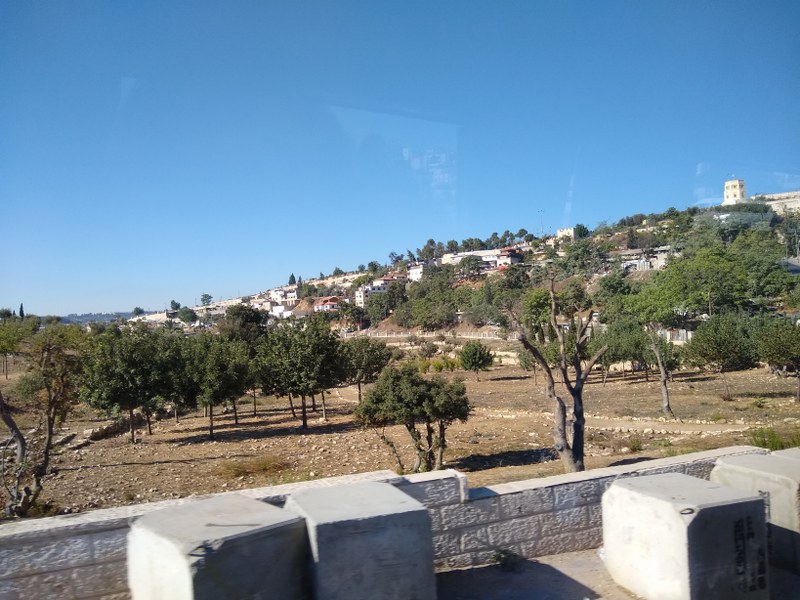
Once again, the morning began with an excellent breakfast at the St. Gabriel Hotel, then we were on the bus, out of Bethlehem and toward Jerusalem. We drove around the western and northern walls of the Old City. Along the way Tony pointed out his "house" to us -- actually a tenement or insula -- just to the west of the Damascus Gate, at the edge of the Christian Quarter. It is "his" house in the sense that all of the residents are members of his family, of which he is the head since the death of his father. As I discussed with him at lunch, their conception of "family" is very different from our own. It is very much an extended family, virtually a clan or small tribe -- brothers, cousins, inlaws, and so forth. If I remember correctly, his "immediate" family numbers six hundred! -- all living together in the building we saw.


Incidentally, its location right on the edge of the Christian Quarter faces directly toward the Muslim Quarter, which has led to it being shot at in the frequent times of tension. Not smart -- Tony shoots back!


The bus dropped us at the peak of the Mount of Olives, the highest of the hills of Jerusalem, the ridge facing the eastern wall of the Old City, the peak of which is one of the sites associated with the Ascension ... marked by a mosque today (although the map above tags it as "Chapel of the Ascention"). The Muslims do revere Issa -- Jesus -- as a prophet who did ascend into heaven. But their beliefs about Jesus are very different from our own, e.g., that he is just a prophet, albeit conceived virginally (by Mary or Miriam ... the sister of Moses!?), who did not die on the cross but was rather miraculously replaced by a lookalike. It is a scandal that they control this site, but luckily they do allow Christians to visit. Inside can be seen two footprints -- not of Jesus, but carved to represent the very spot from which he rose into the heavens.


We started our descent of the Mount of Olives, following the path Jesus would most likely have trodden coming from Bethany to Jerusalem, most notably on Palm Sunday. We proceeded to the Church of Paternoster, one of the places where Jesus may have taught his disciples, at their behest, the only prayer he ever taught them. Tony put it into the context of the aftermath of the raising of Lazarus from the dead, which happened only a short time before Palm Sunday, and nearby at Bethany. That is not precisely how the Bible presents it. Matthew has the Our Father (Matt. 6: 9-13) as part of the Sermon on the Mount (Matt. 5-7); Luke does not, however (Luke 11: 1-4). Personally, I don't see any reason why he could not have presented this teaching more than once over the most likely three years of his ministry, and a final time on the Mount of Olives. In any case, also known as the Eleona, "The Olive Grove," the site is overseen by Carmelite nuns. In a small cave -- Tony explained why the entrance of a cave, its mouth, was the natural spot for simple acoustical reasons for a man to address a crowd -- we recited the Our Father as well as, at Tony's behest, left our written prayers and petitions for the nuns to pray over. 


Once again, there was a courtyard containing plaques of the Our Father in the various languages of the world. In this case, there were more than could be contained in a single courtyard, and plaques were in smaller nooks and crannies here, there, and yonder, to the tune (I believe) of 178! Tony explained why he believes that Jesus would have taught the Our Father to the disciples in Hebrew rather than, as commonly believed, in Aramaic -- and read it to us in Hebrew; in a different area, he pointed out that Chaldean, one of the world's oldest language that is still spoken although he said it would likely be a dead language within twenty or thirty years, is placed directly opposite one of the world's newest languages -- English -- and proceeded to read the Chaldean to us!


Leaving there, most of us purchased olive sprigs and palm fronds from a young man recommended by Tony.


Proceeding a little further down, we entered the expansive Jewish cemetery. The Mount of Olives is a coveted place of burial because the Jews do expect that when the Messiah comes, those buried on the Mount of Olives will be resurrected first. 


The spot also provides a wonderful view of the Old City. Tony got one of his friends -- a seller of scarves whom he had already recommended we buy from, and we would, albeit later -- to use Ingrid's camera to take what would be our official group photo, at the top of this post. There were also a number of individual and smaller-group photos taken, including:


Three Amigos -- Br. Miguel, Fr. Emilio, and myself
(Photo from Ingrid)
We continued down a steep grade to a 1st-2nd-c. cemetery where we could see the niches where bodies would be entombed. After a year, the bones would be removed and placed into ossuary boxes, which we could also see there.


That was very near the Church of Dominus Flevit, "the Lord wept": 


     As he was now drawing near, at the descent of the Mount of Olives, the whole multitude of the disciples began to rejoice and praise God with a loud voice for all the mighty works that they had seen, saying, "Blessed is the King who comes in the name of the Lord! Peace in heaven and glory in the highest!" And some of the Pharisees in the multitude said to him, "Teacher, rebuke your disciples." He answered, "I tell you, if these were silent, the very stones would cry out."

    And when he drew near and saw the city he wept [flevit] over it, saying, "Would that even today you knew the things that make for peace! But now they are hid from your eyes. For the days shall come upon you, when your enemies will cast up a bank about you and surround you, and hem you in on every side, and dash you to the ground, you and your children within you, and they will not leave one stone upon another in you; because you did not know the time of your visitation." (Luke 19: 37-44)


The church is very new, built by the Franciscan Custody in the 1950s on a traditional site associated with the event, where hitherto there had been a small chapel. 
This is the other Catholic church in Israel oriented toward the west, this time across the Kidron valley toward Jerusalem, because that is the direction Jesus was facing, toward the Temple. The teardrop shape evokes the tears of Christ. While digging the foundations remains were found that inspired a wholesale excavation of the site, which unearthed ancient Canaanite as well as more recent Byzantine tombs and a Byzantine monastery, the latter containing mosaic floors incorporated into the church. In the altar is a mosaic roundel of a hen and her chicks, surrounded by the words, “IERVSALEM IERVSALEM QVOTIES VOLVI CONGREGARE FILIOS TVOS QVEMADMODVM GALLINA CONGREGAT PVLLOS SVOS SVB ALAS,” “Jerusalem, Jerusalem, how I have wanted to gather your children like a hen gathers her chicks under her wings,” recalling another lament over Jerusalem:


"O Jerusalem, Jerusalem, killing the prophets and stoning those who are sent to you! How often would I have gathered your children together as a hen gathers her brood under her wings, and you would not!" (Luke 13: 34)


Behind the altar, a great picture window incorporating a host-and-chalice design gives a panoramic view of the city. 


... None of which did we see. We had been told we would have Mass at 10:30 inside the church. Unfortunately, as we arrived, I overheard Tony tell Padre that priority is given to larger groups and that our small group was bumped into an adjacent outdoor chapel (there seemed to be two). Padre's theme was, as usual, that Jesus came here -- knowing what was about to happen to him. "He suffered and he cried here in this place. ... One of those tears is for you. ... Let us be thankful to God for the blessings He has given us here in the Holy Land."


In a large courtyard adjacent to the Church of Dominus Flevit overlooking the city, Tony described what we could see from the Mount of Olives: from the earliest Jebusite city which became the City of David at left, in the south; across to the great extension of Mount Moriah created by Herod the Great which became the Temple Mount, now dominated by the Muslim Dome of the Rock shining brilliantly golden -- beyond which could be seen the grey domes of the Church of the Holy Sepulchre; the walled-up Golden Gate through which (an earlier incarnation of course, since the present walls date only from the 16th century) Jesus passed on Palm Sunday, through which the Jews believe the Messiah will arrive when he comes and Christians believe Jesus will arrive when he comes again -- for which reason the gate has been repeatedly walled up, even by Suleiman the Magnificent shortly after rebuilding the walls with an open gate!; to St. Stephen's Gate through which the first martyr was dragged out into the northern part of the Kidron Valley and stoned to death. We could also see, further down the slope of the Mount of Olives, such other landmarks as the golden spires of the Russian Orthodox Church of St. Mary Magdalene.


We continued our walk down to the bottom of the Mount of Olives at Gethsemane, the "place of the olive press" -- the garden to which Our Lord retreated after the Last Supper, where he suffered the agony of knowing every detail of his coming Passion, where he would be arrested by the Temple Guard, betrayed by Judas. Most of the trees from which the Mount of Olives takes its name are long gone, victims of various wars through the centuries starting with the Romans – who pitched their camps there during the Jewish War and cut down every tree. So although it is often said that some of the trees here in a small enclosed garden are “witness trees,” that is, that they witnessed Jesus’ agony in the garden forty years earlier, that’s probably not the case … for the most part. 
On the other hand, olive trees are among the longest-lived trees there are, and can grow back after being cut down to their roots, so it would not be surprising if one of these trees’ progenitor did stand here in mute witness ca. AD 30 or 33 when God Himself willingly took upon Himself the sins of the world, becoming as the Scapegoat of Yom Kippur. 


Immediately adjacent is the Church of All Nations inside of which is the Rock of the Agony, the spot where Jesus prayed that if possible the cup of his coming Passion might pass from him. Built in 1924, financed by contributions from many nations around the world and incorporating design elements from the earlier Byzantine church, the Romanesque facade with its great triangular mosaic has become one of the most oft-photographed landmarks in Jerusalem. The interior design purposely evokes the darkness and gloom of that Holy Thursday night two thousand years ago.


The Rock of the Agony in the Garden


From there it was only a short walk to where our bus could pick us up to take us to lunch, at the Notre Dame Center, a Vatican property in Jerusalem. Part of the complex is a hotel (which Steve Ray's pilgrims use). Flanking the lobby were two establishments to eat in, a restaurant at left and a buffet at right. Somehow Kristal and I got separated from the group -- we went through the buffet line then could not find them in that area. Tony and Wael, our driver, were there, and waved us over to their table, where we had a very nice visit.


Part of the Notre Dame Centre is a permanent Shroud Exhibit which several of us went into with Fr. Emilio, who gave an explanation of the image on the shroud and how perfectly -- and graphically -- it testifies to the sufferings of Our Lord as described in the Gospels.


After lunch and that short exhibit, the bus took us back to a location near the northern gate of the eastern wall, variously named "Lion's," "St. Stephen's," "Sheep,"  etc. The walk to the actual gate went through a Muslim graveyard, which was not nearly so well taken care of as the immaculate Jewish Cemetery. 


Entering that particular gate took us into the Muslim Quarter of the Old City. The Old City – which is not contiguous with the city of Jerusalem as it was in the time of Jesus, but rather as it developed in the later Middle Ages and more recent centuries, is (very) roughly a square, roughly oriented squarely north-south-east-west, and divided culturally, religiously, and even historically into four unequal quarters – with the Temple Mount cutting into the eastern two quarters. The Muslim Quarter is in the northeast, then clockwise there are the Jewish Quarter (the smallest) in the southeast, the Armenian Quarter where my friend Angel Kitishian grew up in the southwest, and the generically-named Christian Quarter in the northwest. The present Old City is shifted north from the city 2000 years ago, when Mount Zion and the City of David, presently outside the walls (which are largely of Ottoman construction) to the south were within the city while much of the Christian and Muslim Quarters were outside the city to the north. Most obviously, of course, the Church of the Holy Sepulchre, now in the heart of the Christian Quarter, was at that time outside the walls.


Image from Holylandmark.com
Entering the Muslim Quarter of the city we walked to St. Anne's Church, commemorating the traditional site of Our Lady's birth. 


Photo from Ingrid


The idea that this church, just north of the location of the Temple Mount, was in fact the birthplace of Mary engendered a bit of debate among our number, given the fact that Luke places her in Nazareth at the time of the Annunciation thirteen to fifteen years later.  I for one have no problem with the tradition. Michael Hesemann, in his Mary of Nazareth, makes a strong case based on ancient tradition recorded in the apocryphal Protoevangelium  of James and the Gospel of Pseudo-Matthew that Our Lady may well have been born here, in the shadow of the Temple.


This church is famed for its acoustics. Another group was there and a small group did a beautiful rendition of, I believe, the Te Deum. Once they were out, I was privileged to chant the Salve Regina along with Padre Emilio; Kathie and I were discussing getting the group together since most of them knew it when Padre, without being party to our hushed conversation, appeared and started chanting so I joined in. Great minds obviously think alike. Although I didn't perceive it at the time, the video sounds like others joined in as well. And the acoustics were indeed awesome, especially then and there, in the moment.


Video from Kristal

A little later, just before we left, I stood right on top of the star between myself and Padre, and chanted one Non Nobis Domine -- and that was indeed, as I'd read, the sweet spot. Unfortunately, I got no recording.


Not far from St. Anne's can be seen the remains of the Pool of Bethesda, renowned as where Jesus healed on the Sabbath:


     After this there was a feast of the Jews, and Jesus went up to Jerusalem. Now there is in Jerusalem by the Sheep Gate a pool, in Hebrew called Bethzatha, which has five porticoes. In these lay a multitude of invalids, blind, lame, paralyzed, waiting for the moving of the water; for an angel of the Lord went down at certain seasons into the pool, and troubled the water: whoever stepped in first after the troubling of the water was healed of whatever disease he had. One man was there, who had been ill for thirty-eight years. When Jesus saw him and knew that he had been lying there a long time, he said to him, "Do you want to be healed?" The sick man answered him, "Sir, I have no man to put me into the pool when the water is troubled, and while I am going another steps down before me." Jesus said to him, "Rise, take up your pallet, and walk." And at once the man was healed, and he took up his pallet and walked.

     Now that day was the sabbath. ... (John 5: 1-9)

Of course, Jesus healing on the Sabbath was, to the Jewish authorities, worse than the  sick man's lifetime of suffering which Jesus alleviated.

What is now called the Lion's Gate or St. Stephen's Gate was then called the Sheep Gate, because the market for procuring sheep for the Temple sacrifices was just beyond it. I did not walk down to see this pool, however, instead using up all my time in St. Anne's Church. Those who did so saw the following:

Photo from Ingrid
From St. Anne's we went a short distance to begin the Via Dolorosa, the Way of Sorrows, and extended walk of about a quarter mile which is obviously not a "site" per se, but rather a route through the narrow streets of the Muslim Quarter into the Christian Quarter, with various individual locations traditionally associated with the the Stations of the Cross marked by placards on the walls of buildings. 

Image from PlanetWare.com

It is not a dedicated way, by which I mean that the streets are part of the everyday life of the Old City, with all the hustle and bustle of the inhabitants going about their business even as we made our way along it. Businesses, markets, and so forth open directly onto the streets. It is as if a way were marked through the middle of Natchitoches and we were able to walk it devotionally -- which we do, of course, every Good Friday -- but without the police blocking traffic for us and with considerably narrower streets and greater crowds than we experience back home. As millions, at least, through history have done, however, we stopped, meditated, and prayed at each Station -- "We adore you Oh Christ, and we bless you, because by your Cross you have redeemed the world...."


Photo from Ingrid


[Here follows a video from Youtube, of a different group -- not ours -- following the Via Dolorosa in the early morning of 04 Apr 2017]


Proceeding through the narrow streets of the Muslim Quarter, into the Christian Quarter,  we ultimately arrived at the Church of the Holy Sepulchre, called the holiest place in Christendom. The last five of the fourteen Stations are inside that massive church, which encompasses what remains of the mount of Calvary as well as the Tomb in which Jesus "was crucified, died, and was buried ... On the third day, he rose again from the dead..." (The Apostles' Creed"). The sites of the Crucifixion and the Resurrection are really within just a few yards of each other (contrary to most people’s mental image), and all beneath one roof within the walls of this great church.


It is pretty much as certain as certain can be, historically speaking, that this is indeed the site of Golgotha/Calvary and the Tomb. It was revered as such from a very early period – at least the 2nd c., when according to the early church historian Eusebius the Roman Emperor Hadrian built a temple dedicated to the goddess Venus atop the site to preempt Christian worship there. Two hundred years later, the first Christian Emperor Constantine the Great ordered the temple to be replaced by a church – during which construction his mother, St. Helena, is said to have rediscovered the tomb and the True Cross. In the process of the construction, much of the rock of Calvary and around the tomb was removed in order to isolate the two sites and level the ground. Constantine’s church (actually two adjacent chapels in one complex) was damaged by wars, attacks, and earthquakes through the subsequent centuries – the Persians in 614 when they captured and carried off the True Cross (recovered and restored by the Emperor Heraclius in 630 – the 14 September Feast of the Exaltation of the Cross), long centuries of Muslim rule from 638 – until 1009 when the Mad Caliph Al-Hakim ordered it destroyed completely, and helped set up the beginning of the Crusades by the end of the 11th c. despite a meager rebuilding negotiated by the Byzantine Emperor and Al-Hakim’s son at mid-century.

The current building is perhaps the greatest monument to the First Crusade, called in 1095 at least in part to restore the Holy Sepulchre. Their capture of Jerusalem on 15 July 1099 inaugurated most of a century, the 12th, of Christian rule over the Kingdom of Jerusalem. By 1187 when Saladin took the city, the great church as it exists today was more or less in place although there have been, of course, extensive repairs, renovations, and even expansions through the following centuries. Like the Basilica of the Nativity, management of the Holy Sepulchre is a complicated “cooperative” between religious communities – Catholic and multiple Orthodox – with even more jealously guarded claims, rights, and privileges given rise to sometimes ridiculous oddities such as the workman’s ladder which has stood in one place for over a century and a half because to remove it would violate one or the other denomination’s rights!

(As an aside, here too there is an “alternative,” however. Protestants generally prefer what is known as “the Garden Tomb” some distance away, “rediscovered” in the 19th century by British Major-General Charles Gordon – but no reputable scholar today, Catholic or Protestant, disputes the location of the Holy Sepulchre. Even the Protestant trust overseeing the Garden Tomb refrains from promoting it as the very site, rather emphasizing it as better representative of the site described in the Bible. Perhaps it is ... but it is not the spot.)


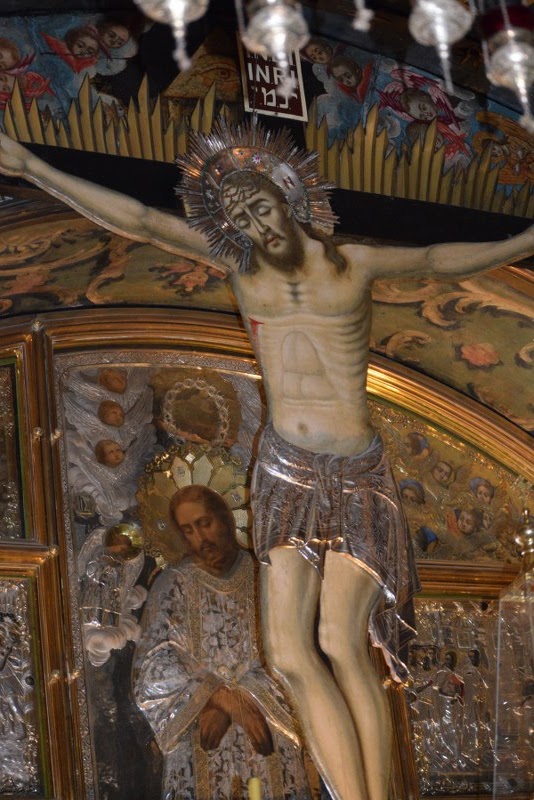
Inside the Holy Sepulchre, one can ascend to the top of Golgotha and the site of the Crucifixion and touch the actual rock; one can see the Stone of Unction, where Jesus’ body was laid out for hasty preparation before entombment; and view the Tomb, which was renovated to much fanfare within the past couple of years. But one cannot do those things quickly.... We were in the Church  for a long time, and indeed our praying of the last five Stations of the Cross broke down simply because of the press of people, the bustle and the noise. There was no way for us to stay together as a group and pray. We did make our way in and up to the level where a small shrine encompassed a hole down which one could stick one's arm pretty much up to the elbow and touch the naked rock of Golgotha. The wait there was between a half and a full hour. 


See the infamous ladder below the middle window?


Photo from Ingrid
Photo from Ingrid
Photo from Ingrid


Then, back down stairs we saw -- and touched -- the Stone of Unction, where the Blessed Mother and her companions washed and anointed His Body once it was taken down from the Cross. 


Then we went into the main part of the church -- the Rotunda at the center of which is the small chapel, the Edicule, in which is the Tomb itself. The shelf on which His Body would have been lain is now covered by a marble slab, but we were allowed in to pray before it ... after a wait for well more than two hours. It was not a line; it was simple a mass of people pressing to get through a very small door for a few seconds in that holiest place in Christendom, where Our Lord was dead and rose again to life. It was hot; people were rude (especially a group of Russians, one woman of which kept pressing to push me out of the way, and when I pressed back to hold my place she looked at me and either hissed or spat; I looked back at her and said, "Pfft to you too!" Not my finest moment, but tempers were short all around. The line moved inches at a time, and stopped entirely twice, once when the Franciscans sang Vespers, I believe, and once to accommodate a group of Knights of the Holy Sepulchre who can show up unannounced and immediately be given precedence, private access to the tomb for thirty minutes. But Tony assured us we were actually lucky -- imagining the circuit of the Edicule as a clock with the entrance at 12:00, we began our wait at about 04:00; Tony said he had seen the "line" filling the Rotunda, extending out into the plaza and into the street, with a wait lasting many hours.


Note, at about 06:00 of the circuit was the entrance of a small Armenian chapel in which I lit (or rather had one of our number light, because there was no way I could maneuver my way there in the crowd!) the last of the many candles I set all across the Holy Land for my friend Angel and her family, as I had promised to do. Angel grew up in the Armenian Quarter.


Photo from Donna


The wait was worth it. Being there in the Tomb was a profoundly moving experience although it lasted only a minute or so. A monk was moving pilgrims in and out in groups of five or six one after another, no nonsense. That was a thankless job, I'm sure! He allowed no pictures, but here is a shot I found on the Internet:


http://www.investingbb.com/sepulcher-tomb.html

Exiting the Tomb, we were to gather in the courtyard. Passing by the Stone of Unction, the crowd had thinned considerably, and some of our number venerated it again without the hustle and bustle.


[An excellent overview of the Church of the Holy Sepulchre, with diagrams and high quality images of the 90% or so that we did not see can be found here: LINK]


Once we came out of the Church, we had initially been planned to walk across to the Western or "Wailing" Wall. Given the lateness of the hour -- it was past 19:00 -- the length of the walk, and Tony's advice, we ended up walking through the Christian Quarter and ultimately out the Jaffa Gate to meet our waiting bus, to be taken back to Bethlehem and our last night in the St. Gabriel Hotel. Along the way we passed by the Razzouk Tattoo Parlor; I asked Tony, "Is that the famous tattoo parlor?" He answered yes -- and that it was where he got his tattoos. At one time I had hoped, time allowing, to come away with a traditional pilgrim's tattoo of a Jerusalem Cross on my right wrist, but time did not allow. And once I got the Jerusalem Cross ring at the Nativity Souvenirs Co-op that was off the table anyway.


As we arrived back at the St. Gabriel, another bus was leaving a new group of pilgrims, a couple of dozen Ethiopians, and suddenly that hotel which had been very quiet got very busy, with a full buffet laid out for both parties, us and them.


After supper, Kristal and I took the opportunity to go down to the bar one last time to bid Tony farewell, although we did not order anything. Both of us had a lot of packing to do in order to get to bed at a decent hour, because we were told to have our suitcases outside our doors no later than 05:15 for a planned departure at 05:45.


And so ended, for all intents and purposes my (hopefully just the first) pilgrimage to the Holy Land.


+ + +

Here is an interesting little addendum, however. In the evening, as we packed, there was a flurry of posts of pictures going up on WhatsApp. Among them, Br. Miguel posted the following....
A "consecrated layman," he is an architect by training (and was, I noticed throughtout, taking pictures that were often focused on the architectural feachers of churches we were visiting), but he is also an artist. So is his mother. She painted the above portrait of the Virgin Mary, pregnant with Our Lord, some time back and presented it to his religious community. Quite a good painting, what is really interesting about it is that, if you look at Our Lady's abdomen, very faintly you can see the Holy Face of Our Lord. 

Br. Miguel says his mother did not paint that image -- rather, it started appearing very faintly, about a year after she presented it to his community. I believe what prompted him to share it with us was our short visit to the Shroud of Turin exhibit at the Notre Dame Center earlier in the day, and there is indeed a close resemblance between this image and that of the Shroud -- its coloring; its faint, ethereal nature; how it actually looks more clear to the eye if you do not look directly at it. But most of all, the features -- it is clearly the same face, but portrayed here in life rather than in death. As I understand it, the "apparition" has not been declared to be miraculous -- as yet. But it is under investigation by the Vatican. At this point, Miguel says, no natural explanation has been proposed for its appearance.