Showing posts with label Nativity Pilgrimage. Show all posts

31 August 2018

2018 Holy Land - Reflections on the Pilgrimage

It is hard to believe that it is nearing three weeks since I departed on my pilgrimage to the Holy Land and well more than a week since I returned. As usual, the time immediately before departure seemed both incredibly long and incredibly short (especially in the last days in the midst of my pre-departure misadventure); the time on the pilgrimage likewise both long and short; but the time afterward has flown by. It is one reason I have been working like a Trojan to get my blog record of the trip fleshed out with as much detail as I could as well as get as many pictures as possible posted to their correct places, before all the little details start receding into the mists of time. Not only have I been reliving the experience by so doing, I have been ensuring I can go back and do so in the future, but most importantly, I think, I have been processing it all. Now, having finished the blog series on “2018 Holy Land,” I feel ready to reflect on it with the benefit not only of my own ruminations but also of discussions with friends who have been eager to hear all about it and who have posed a number of questions that have forced me to think about the experience as a whole and try to figure out how to convey to them just how wonderful it was.

I’ll begin with a couple of the most frequent questions I've gotten: Did you feel safe? and What did you like best?

As to the first of those questions, the answer is a resounding Yes – at no time during the six days we were on the ground in Israel – and in the Palestinian Territory – did I feel unsafe. With the given, of course, that I was part of a group and therefore not “on my own,” I still say with all sincerity that even more so than Mexico when we were there in 2016, the reality on the ground is very different than the impression given by the news media. I was perhaps a bit more expectant of what turned out to be the reality since I did watch through the entirety of a couple of Steve Ray’s videoblogged pilgrimages from earlier in the year – one before and one after the uptick in tensions and reported violence in May – and perceived pretty much no effect on a pilgrimage group much like our own; I also started pulling in feeds from Israeli news media on the private news aggregator I set up just for myself, and although there was of late a good bit of frank discussion of the ongoing tensions and larger issues to do with them, as well as the specific unrest currently churning down on the Gaza Strip, by and large the impression I got was of a peaceful country in which the people went about their daily lives with a feeling of security, not in constant fear for their lives that western media reports would seem to indicate must be the situation. And that security does not seem to exist at the cost of some kind of visibly omnipresent police/military presence. Contrary to what people I talked to who have travelled to Israel, whether on pilgrimage or not, seemed to indicate, we did not see an armed security presence everywhere. To be sure there probably was more of a presence than I perceived – I imagine they would not want to be seen, that they would want to be discreet however vigilant and ready to act quickly and decisively – but the fact is whatever security presence there was in Israel was considerably less visible than it was in Mexico. With the exception of the checkpoint agents at the Security Wall going into and out of Bethlehem, I noticed armed security on just three occasions. Most notably, there was a small security station on the Via Dolorosa right where it passed out of the Muslim Quarter of the Old City into the Christian Quarter. I don’t specifically remember where the others were, but they did not seem to be in any specifically memorable position other than that – which I imagine is an intersection that violence might be expected when tensions inevitably flare up.

But to make a long answer short – Yes, I felt absolutely safe the entire time. Even in Bethlehem – although I must also say that our guide made it crystal clear that Bethlehem and the West Bank – the Palestinian Territory – is not Israel, and is a different situation entirely with regard to safety. As I wrote in the blog, as we approached Bethlehem for the first time after several days in northern Israel, preparing to pass through the Wall and make our way to our hotel, he cautioned us very seriously to be vigilant if we leave the group or the hotel, and not to do so after dark. It was never an issue. The only times we left the hotel were as a group, as far as I know. In other circumstances it may have been different, but frankly our schedule was such that we rolled out right after breakfast and only returned in time to unwind in the hotel bar for a little while before supper, the with prospect of an early morning start to send us to our rooms rather than be tempted to go “out on the town” (if anyone from our group would have been so tempted). The only exception to what I just said was that, I found out afterward, late one afternoon the couple I rode to and from Houston with did walk down to an ATM that our guide suggested – and had no problem other than that the ATM “ate” his card. They didn’t report any unease in making that daytime excursion.

But that is way too much space given to an issue that was no issue. Yes, I felt safe.

As to what I liked best on the whole trip, it’s really a conundrum – how to decide? It also depends on exactly what you mean by that question. I’m taking it as, what specific holy place or sight in general did you find the most moving? … Yeah, it’s still a conundrum – how to decide? There was so much – but hit with that question at, I think, the first real get-together I had with any friends after arriving back home, my mind immediately went to one thing, and I’m sticking with it – the Noon Angelus Procession by the Franciscans at the Basilica of the Annunciation in Nazareth. I heard them come out chanting Ave Maris Stella (I believe) and for the next ten minutes or so I was in hog heaven. I really did turn to one of my fellow pilgrims at the end and say, “Tell me it’s not better in Latin!”

Of course, that is not to denigrate in any way all the other holy places we saw, holy spots I touched – each of which had its own profoundly wondrous appeal just from the knowledge that I was seeing – touching – places where heaven had in one way or another come down to touch the earth. As Fr. Emilio refrained, again and again, in his homilies – It was here, in this place.

[Side note: Another of my post-travels exercises, in order to distill a thousand or more photographs down into a manageable subset easy to show – believe me, people do not want to be bored with the full set, most of which are duplicates, of things that have meaning only to yourself, or just not that good as snapshots taken on the fly – and have them printed in a nice photobook. I’ve done for one each of the other pilgrimages I’ve made and the result is, in my opinion, nicer than printing out photographs and putting them into a photo album. This time, I anticipate two volumes, most likely – one for Galilee and one for Jerusalem and its environs – and I’m going to name them respectively, It Was Here and In This Place.]

The importance of place is something I truly realized only during and after my first real – and belated – excursion to England and Scotland in 2008, after well over a decade as a historian specializing in those areas during the early Middle Ages. Walking the battlefield at Hastings or on Hadrian’s Wall (and I could multiply examples) gave me a sense of connection to events that hitherto had been, I realized, little more than stories. I suddenly felt a connection with events and persons 1000 or 1500 years gone. That was true for the events of English and Scotland I’d long studied – but it was nothing compared, I found in 2014 on the pilgrimage to Italy or that to Mexico in 2016, to walking in or touching the places important in the history of my Faith. And those paled beside the experiences I had in the Holy Land. The closest previous was being in the presence of the tilma bearing the miraculous image of Our Lady from almost five hundred years ago. But now I touched the place were, at least according to tradition, she was born – where John the Baptist was born – where Our Lord Himself was born; was within feet of the place where the angel announced to Our Lady that she would conceive and bear a son who would be God Himself; walked – if not in the very footsteps of Our Lord on his way to Calvary, at least very closely to them; I touched the very peak of Calvary, where He suffered and died – then touched … well, at least the marble slab covering … the shelf in the Tomb where His Body was lain, and from which He rose again.

There is no way to describe how moving those moments were, so I don’t ever try. But I do recommend them. Take it from me, there is no place like place.

Of course, important in any activity – even a pilgrimage – which is done in a group, is the individuals who make up that group. The way I have been putting it is, There was not a single pebble-in-the-shoe among this group! I could not have asked for better travel companions – especially in my suddenly debilitated state that arose only days before we departed. From Kathie and Robert who had already, a couple months before, offered me to ride with them to and from Houston, to Mary the nurse who found herself professionally consulted when my pacemaker-pocket incision seemed inflamed to me; from Ingrid who kept me on my toes with questions about everything we were seeing once she found out I’m a history professor and has shared with me a thousand or more wonderful pictures taken with a real camera (and reported back to her son, one of our seminarians, who reported back to our diocesan Director of Vocations, who reported back to his parents, dear friends of ours, who reported back to my wife that they were all looking out for me and that I was doing just fine), to Angela who somehow found my lame sense of humor funny and offered to carry some of my acquisitions in her voluminous bag when I was trying to juggle a hat (on and off and we went in and out of churches) and two phones with only one working hand, and Maria with whom I found I could make comic-book movie allusions and have somebody on this pilgrimage get it (I did not expect that!); from Jennifer with whom I chanted the Gloria in the chapel at Shepherds' Fields, to Ann and Donna; from my wife’s sister-in-law Kristal, a late addition to the pilgrimage, a Baptist who fit in perfectly with this group of Catholics and mother-henned me more than any of them, to my infinite gratitude – to Brother Miguel whom I don’t think anybody ended up calling “Mike,” who was funnier than I’d imagined any “religious brother” would be, especially when he procured the keffiyeh and robes and mounted up on the camel like Lawrence of Arabia! And especially Padre Emilio, who put this pilgrimage together, put up with a number of liturgical chant faux pas on my part ("The Mass of the Double Sanctus"), and kept us in mind throughout that it was here, in this place….

I miss you all. 

(Especially singing the theme from Rawhide ... how did that get started?)

A good guide can also make-or-break any tour, religious or otherwise. We had the best. While not being a specialist in Biblical history, I consider myself fairly well read in the subject – and I found my knowledge paled beside his own as a Biblical archaeologist actually working there in that place. I was able to “talk shop” with Tony, to a degree, but most importantly I just listened to him and learned so much! He was congenial, funny, easy to get along with – and a fount of knowledge not just about all the places we went to but, with great passion, about the conditions of his fellow Christians in the Middle East, which I will return to in a moment.

Finally, the oft-forgotten wheels that keep things moving, literally. One of the regrets I have, after putting out the call to my fellow pilgrims seeking a picture of him and coming up nada, is that our driver is at this point just a name to me – Wael. I’ve had good drivers in all my excursions, but I think he was the best. He maneuvered that bus in ways I don’t think is humanly possible. As I told him at one point after shouting approval to Tony for something I don’t remember specifically, “Tony, you are The Man!” – “Wael, Tony might be The Man, but the way you drive this bus, you’re The Other Man!”

As I intimated just a moment ago, I learned at lot on this pilgrimage. Perhaps the most important thing was how blind we Christians are in the west to the tragic state of our brethren in the east. Yes, we’ve heard about the persecutions of Christians by the so-called “Islamic State” in Iraq and Syria – and been outraged by our own governments’ preferential treatment of Islamic “refugees” over the many, many Christians who are being systematically eradicated from Islamic lands – but we never hear about the lamentable conditions being endured by dwindling numbers of Christians in the very birthplace of our Faith – in Bethlehem itself. I wrote about this in a couple places in the blog proper, and won’t repeat the details again, but I summed it up pretty succinctly – They are not even given the dignity of being correctly identified as “Aramaean Christians,” what they have long called themselves as natives of the land from which Christianity sprang, but rather have been lumped in with their Muslim Arabic neighbors under a new “national identification” based solely on geography, as “Palestinians” – and being caught in the middle, with the Israelis considering them “Palestinians” and the Muslims considering them Israeli collaborators. Trapped in enemy territory, behind the "West Bank Security Wall," their straits are desperate. Given what Tony said about the implosion of Christianity in Bethlehem since 2000, I fear we are just one Intifada away from losing Bethlehem altogether, a tragedy for those poor people far and away beyond the tragedy it would be for the Church as a whole.

Which brings me at last to our travel broker, Nativity Pilgrimage. Tony is passionate about this – of all the many Catholic pilgrimage companies there are out there, Nativity Pilgrimage is the best. In his case, he’s talking about its legitimacy. For Nativity, the pilgrimage business is not just a business, it is an apostolate, a mission, whose purpose is beyond anything else to enlighten the world about the true state of Christianity in Bethlehem and the Middle East and to do what it can to help the brave Christians who have refused to give up and leave, who are determined to keep at least a toe-hold in their – our, as brother Christians – homeland, not to let Bethlehem become another Nain. It does so by providing top-notch service. I have been on pilgrimages brokered by Magnificat (to Italy) and by 206 Tours (to Mexico City), and I say absolutely this was the best overall experience of the three. They were all good, mind you – but this was the best. Everything went off flawlessly – even with a bit of a hiccough there at the beginning of the summer when it looked like low numbers might scuttle the whole deal. And this great service was provided at a price that neither of those others could touch – without sacrificing on quality. We stayed in the very same beachfront hotel in Tiberias that Steve Ray’s pilgrims are treated to – and having checked out his prices they are a lot higher than what we paid for almost exactly the same package. I’m told that Nativity Pilgrimage cut Radio Maria a special rate on this pilgrimage because Jacob, the owner, is a supporter of Radio Maria and its mission, but looking on the Nativity Pilgrimage website reveals that their regular prices are still fantastic. From what I can see, Nativity Pilgrimage talks the talk and walks the walk, and I will plug them whenever and wherever I can.

I just have one more thing to say about this pilgrimage. Hopefully I’ve conveyed how wonderful an experience it was. I would just like to end with the first words I said to a friend whom I urged to come with my on this journey, but who passed, when I saw him upon my return – “If you ever get a chance to go to the Holy Land again, don’t pass it up!”

I certainly won't.


+ + +


Finally, just for kicks, since I don’t think we did anything on this trip on the day that was scheduled (except fly in and out), here is a comparison of our initial Itinerary vs. the Reality….

Day
Itinerary
Reality
1
Fly out of Houston
Fly out of Houston
2
Land in Israel
Drive to Tiberias
Land in Israel
Drive to Tiberias
3
Mt. Tabor
Cana
Nazareth
Capernaum
Tabgha
Peter’s Primacy
Galilee boat trip
4
Capernaum
Tabgha
Peter’s Primacy
Galilee boat trip
Cana
Nazareth
Mt. Tabor
5
Bethlehem
Ein Karim
Depart Tiberias
Haifa-Carmel
Jaffa-Tel Aviv
Arrive Bethlehem
6
Mount of Olives
Mount Zion
Bethlehem
Mount Zion
7
Jerusalem Old City
Via Dolorosa
Holy Sepulchre
Western Wall
Free time
Ein Karim
Jericho
(Qumran)
Dead Sea
8
Jordan River
Jericho
Qumran
Dead Sea
Mount of Olives
Via Dolorosa
Holy Sepulchre
9
Flight home
Flight home

Well, I was wrong … we went to Mount Zion on the right day!

Mind you, I have no complaints. We gained Mount Carmel at the price of Qumran (which we did see from the bus, hence the parentheses), a muddy dip in the Jordan trickle, and the Western Wall. I can certainly live with that.

I do regret somewhat losing Day 7-afternoon's free time in the Old City of Jerusalem, however.

As I discussed in the blog itself, moreover, there were two sights I would have liked to see but were never on the itinerary – Banias in the north, and Masada in the south. Considering geography alone, those two together would have added at least a full day to our stay and required a bit of reshuffling of the schedule. Not that reshuffling was a problem....


Maybe next time….

19 August 2018

Sunday 19 August -- 2018 Holy Land Day 7: Ein Karem, Jericho, the Dead Sea

Bethlehem in the morning
It was a pretty normal morning -- up, dressed, breakfast, then heading out for another full day. One perceived difference was that it was pleasantly cool when we boarded the bus to head out, and remained so for most of the morning. The afternoon would make up for that, though!

We left out of Bethlehem, passing through the Wall checkpoint again without incident, driving up around the west of Jerusalem toward Ein Karem, the birthplace of John the Baptist. Along the way, Tony expanded on his own deep Christilean roots in the Holy Land. Among his ancestors he claims Maltese Crusaders as well as a direct line of descent from the native Christians of the Holy Land as far as records will carry him -- which is 1400 years, all the way back to the devastating Persian conquest in the early 7th century when a lot of records were lost.


We also passed the large Israeli Holocaust Memorial complex, Yad Vashem, on the forested western slope of Mount Herzl, "the Mount of Remembrance." It is  more than just a museum -- it includes a school, as well as archives and a library. There is also a section of train track and one of the cattle cars in which victims were transported to the death camps. 

Our first stop in Ein Karem was the Church of the Nativity of St. John the Baptist. We saw the very site, which is marked by what I believe Tony said is the oldest Jerusalem Cross ever found. 


Photo from Ingrid


Outside the church, we recited the Benedictus, the Canticle of Zechariah, proclaimed when he regained his voice after the birth of his son, which is posted on a series of plaques around the courtyard in many different languages.

Blessed be the Lord, the God of Israel;
he has come to his people and set them free.

He has raised up for us a mighty savior,

born of the house of his servant David.

Through his holy prophets he promised of old

that he would save us from our enemies,
from the hands of all who hate us.

He promised to show mercy to our fathers

and to remember his holy covenant.

This was the oath he swore to our father Abraham:

to set us free from the hands of our enemies,
free to worship him without fear,
holy and righteous in his sight
all the days of our life.

You, my child, shall be called the prophet of the Most High;

for you will go before the Lord to prepare his way,
to give his people knowledge of salvation
by the forgiveness of their sins.

In the tender compassion of our God

the dawn from on high shall break upon us,
to shine on those who dwell in darkness and the shadow of death,
and to guide our feet into the way of peace.

(Note: This is not the translation that was posted. It is instead the one that I am most familiar with as printed in the Liturgy of the Hours. I will follow the same practice for the Magnificat and any other such prayers we come to.)


Then we took a long half-mile walk, uphill all the way ("many steps"!), to the Church of the Visitation. Along the way we recited the Rosary. I led the last decade right at the gate into the courtyard right outside the church; instead of concluding in English, I continued without pause directly into chanting the Salve Regina in Latin. Almost everyone joined in, I believe. 


 It was right at 10:00, time for Mass in the main Church of the Visitation, commemorating Mary, newly pregnant with the Son of God, came to her aged cousin Elizabeth, six or more months along in her own miraculous pregnancy:

     And the angel said to [Mary] ... "And behold, your kinswoman Elizabeth in her old age has also conceived a son; and this is the sixth month with her who was called barren. For with God nothing will be impossible.” And Mary said, “Behold, I am the handmaid of the Lord; let it be to me according to your word.” And the angel departed from her.

     In those days Mary arose and went with haste into the hill country, to a city of Judah, and she entered the house of Zechariah and greeted Elizabeth. And when Elizabeth heard the greeting of Mary, the babe leaped in her womb; and Elizabeth was filled with the Holy Spirit and she exclaimed with a loud cry, “Blessed are you among women, and blessed is the fruit of your womb! And why is this granted me, that the mother of my Lord should come to me? For behold, when the voice of your greeting came to my ears, the babe in my womb leaped for joy. And blessed is she who believed that there would be a fulfilment of what was spoken to her from the Lord.” (Luke 1: 35-45)


Mary as the Ark of the New Covenant explains why the preborn John the Baptist leapt in his mother’s womb. In the Old Testament, the Ark of the Covenant was the dwelling-place of God Himself, before which King David danced as it was brought into Jerusalem. Mary, in conceiving Jesus, became the dwelling-place of God Himself. When the Ark of the Covenant was brought into Jerusalem, David danced before his God. When Mary approached Elizabeth, John danced before his God.

 In his homily, Padre's theme was: Mary came here in haste, from Nazareth, on foot, a journey comparable to our own of a couple days ago which took us a couple hours driving all told, in air-conditioned comfort. Hers was much longer, much less difficult, much less comfortable. (An amusing story. I had offered after the first day to start chanting the Responsorial Psalms, which I then did at every Mass. Just the day before I had proposed to Padre that we chant the simple Latin Mass Parts at least for Sunday, which he had okayed as well. And then I proceeded to mess it up. For whatever reason, I zoned out after the Creed if we said it this particular day; I may even have dozed off for a moment sitting up -- by this point in the pilgrimage I was dragging a bit. Whatever the reason, I suddenly zoned back in, heard Padre say something about "and we say...." -- and thought it was time for the Sanctus, which I launched off into. Others joined in after a moment, but since I often sing with my eyes closed if I know the piece fairly well, I didn't see what others reported to be an amused grin on Padre's face -- because he had actually been introducing the Intercessions! I only realized it when Br. Miguel took up with the Intercessions immediately upon us finishing the Sanctus. All I could do was a quiet face-palm. So, in my mind at least, our Mass at the Church of the Visitation became the "Mass of the Double Sanctus." And, of course, I was wide awake from that point; sudden humiliation with a side of adrenaline kind of does that....)

The Church of the Visitation contains magnificent paintings of scenes both from the Bible and from Christian history – Mary and Jesus at Cana; the 431 Council of Ephesus where the question of Mary’s status as Mother of God was definitively decided; Duns Scotus, the great Franciscan philosopher who advocated for the understanding that Mary was not just born and lived without sin, but was indeed conceived without sin through the prevenient grace of God (the Church of the Visitation is under the authority of the Franciscan Custody of the Holy Land); the 1571 Battle of Lepanto – 07 October (now commemorated as the Feast of Our Lady of the Rosary) – … and of course, the Visitation itself.


High on the back wall of the church is one of the most beautiful paintings of the Virgin and Child I've ever seen, modernistic though it be:


 Not in the church itself, but in a room adjacent can also been seen a huge rock set into the wall -- the "Rock of the Hiding," behind which an angel is said to have hidden the baby John the Baptist when Herod’s soldiers came to kill all the babies under two years old. Ein Karem was fairly close to Jerusalem (it's part of the city now) and would have been part of that jurisdiction. A painting above depicts the scene.

In the courtyard outside, like in the church at the bottom of the hill, there are many plaques displaying Mary's song which followed immediately from the Visitation quoted above -- The Magnificat (again quoted in a more familiar English translation):


My soul proclaims the greatness of the Lord,

my spirit rejoices in God my Savior
for he has looked with favor on his lowly servant.

From this day all generations will call me blessed:

the Almighty has done great things for me,
and holy is his Name.

He has mercy on those who fear him

in every generation.

He has shown the strength of his arm,

he has scattered the proud in their conceit.

He has cast down the mighty from their thrones,

and has lifted up the lowly.

He has filled the hungry with good things,

and the rich he has sent away empty.

He has come to the help of his servant Israel

for he has remembered his promise of mercy,
the promise he made to our fathers,
to Abraham and his children for ever.


Padre, Angela, and Maria
(Photo from Ann via WhatsApp)
Donna, Kristal, Ann, Jennifer, myself, I
ngrid, Br. Miguel, Kathie,
(Photo from Ann via WhatsApp)


We walked back down. Halfway, we stopped at another religious articles store vouched-for by Tony. I think it may have been connected with the Sisters of the Rosary, who also run a guest house for pilgrims. At the bottom of the walk -- a gelato shop!


Then we took a long bus ride into the Judaean Wilderness to the east, to Jericho, descending from Jerusalem's altitude of about 2500 feet above sea level to about 850 feet below sea level. The thicker air plus temperatures pushing 100F were not nearly so pleasant as the morning had been, even though the humidity was pretty low. Along the way the stark contrast with the western approaches to Jerusalem was impressive. There is pretty much nothing here but rocks. And yet we did see some ramshackle Bedouin camps as well as the goats they herd. Amazing.


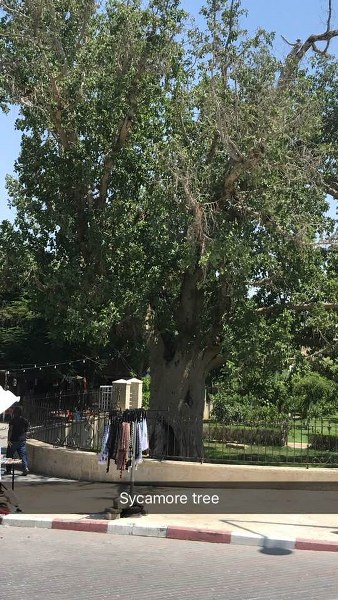
Sycamore Tree
Photo from Kristal
Photo from Kristal
Jericho - Tony's house near center
Photo from Ingrid
 Jericho is, however, an oasis -- literally -- with gardens and orchards, by comparison with the surrounding landscape downright lush and green. Looming over it all -- the Mount of Temptation, where Jesus spent forty days and forty nights fasting immediately after his Baptism in the nearby Jordan River. (By the way, we did not go there; Tony gave us the option, but said that this time of year we would only see a bare trickle of water 
through a narrow ribbon of mud in a mostly dry river bed. We opted out.) Tony pointed out that, given the proximity, during his long fast, culminating in the Temptations for which the mountain is named, Jesus could have seen immediate relief from the torments of hunger and thirst looming below him.

As we pulled in to an open-air bazaar facing the Mount of Temptation, Tony pointed out his own vacation home some distance away in Jericho itself. 

Some of our group rode a camel there. We went into a couple of shops as well -- including the main (I believe) Dead Sea Company store, where I was able to get Anne some of the cosmetics and soap products that I had seen but passed up at the Nativity Souvenir Co-op yesterday (and which I will always associate with our breakfast companion in Shrewsbury, England, ten years ago now -- my repeatedly hearing the young lady saying she worked for the "Detsi Company" until she said it very slowly for me! [LINK, Tuesday 25 March]).
Photo from Ingrid
Leaving Jericho, we drove past Qumran where the Dead Sea Scrolls were discovered in 1947. Tony told us the story of the most important archaeological discovery of the 20th century: A young Bedouin goatherd, seeking a stray, cast a stone into one of the many caves dotting these cliffs. He was startled to hear the sound of clay pottery shattering. Hoping to find treasure, he did -- just not the kind he expected or even recognized as such. Some of the many clay jars contained old scrolls, most in fragments. As it turned out, some were copies of Hebrew scriptures a thousand years older any any existing Biblical manuscript. The result was a revolution in Biblical studies that is still ongoing.

But we did not stop there -- Tony said it really was not worth it and just showed us the caves in which the scrolls were discovered, visible from the road, as he told us the story of the Qumran community of Jewish "monks" called Essenes -- and we continued on.


We reached the Dead Sea. Some of our number did go "bathing" or "floating"; knowing of my recent pacemaker implantation, Tony flatly forbade me -- and indeed I saw a sign warning against heart patients and those "owning" high blood pressure entering the highly salinated and mineralized water. I did walk down to the water's edge, take some pictures, then trudged back up a ways to "The Lowest Bar in the World" and had a really good Goldstar Dark Lager at about 1300 feet below sea level. It was quite pleasant, especially since I'd snagged a table by an evaporation air cooler. tAfter a while, most of our "floaters" having gone back up, I trudged the long walk back up to the entrance mall where I found most of our number in a cantina around another evaporation air cooler.


"DEAD SEA BATHING DANGEROUS [TO]
HEART PATIENTS AND OWNERS
OF HIGH BLOOD PRESSURE"


VIDEO


About 16:00 we rode back toward the hotel, back through the Judaean wilderness, arriving a bit after 17:00. We had some free/rest time until 19:00.


I mentioned above, upon leaving Galilee, that there were two things that I would dhave liked to have seen that were not on our itinerary, both doubtless in consideration of time and cost (time is money), in part because both would have required fairly long drives out of our way. In the north there was Banias; in the south there was Masada – Herod the Great’s fortress atop a great rock which served as the last bastion of Jewish resistance against the Romans after Jerusalem fell and the Temple was destroyed in AD 70, at the end of the Jewish War. It was ultimately less Roman military force than Roman military engineering that brought the fall of Masada – the remains of a great ramp built by the Tenth Legion under General Flavius Silva stand even today in remembrance of how the Romans ultimately moved their siege engines into place 1300 feet above the desert floor, against the walls of the fortress, and breached them … to find that a thousand Jewish rebels had committed mass suicide rather than be slaughtered or taken. That happened in either AD 73 or 74 – amazingly, we are not absolutely certain which, but then Josephus could be amazingly careless with his chronology. Masada looms over the Jewish psyche even today, a rallying cry more powerful by far even than Texans’ “Remember the Alamo!” or the Greatest Generation’s “Remember Pearl Harbor!”


Inside the St. Gabriel Hotel:
(Bottom to top, left to right)
Kathie, Robert, Donna, Ann,
Kristal, Kent, Jennifer, Mary,
Ingrid, and Br. Emilio

(Photo from Kathie)
For dinner tonight we went out of the hotel back across to Shepherd's Fields, to the Grotto Restaurant across from the one we had lunch at yesterday. There we had, a night early, our semi-formal "farewell dinner." It was virtually the same menu as lunch yesterday, but maybe even better. Hatem, the local head of Nativity Pilgrimages, was there and joined us, as did Tony. There were thank yous and testimonies all around -- as to the value of Nativity Pilgrimages and the work it does as not just another tour company, not even just another pilgrimage company, but indeed a ministry or apostolate to, among other things, support the native Christians of the Holy Land especially those identified as "Palestinians." That is one of the most important things I think I have learned and experienced on this trip, that there is a whole group of essentially original Christians whose story is not told, or even worse, misrepresented. The other topic was the role and value of Radio Maria, and almost everyone there's important role in that apostolate.


It would have been a good way to end the pilgrimage ... but we have one more day. Tomorrow -- Jerusalem.